
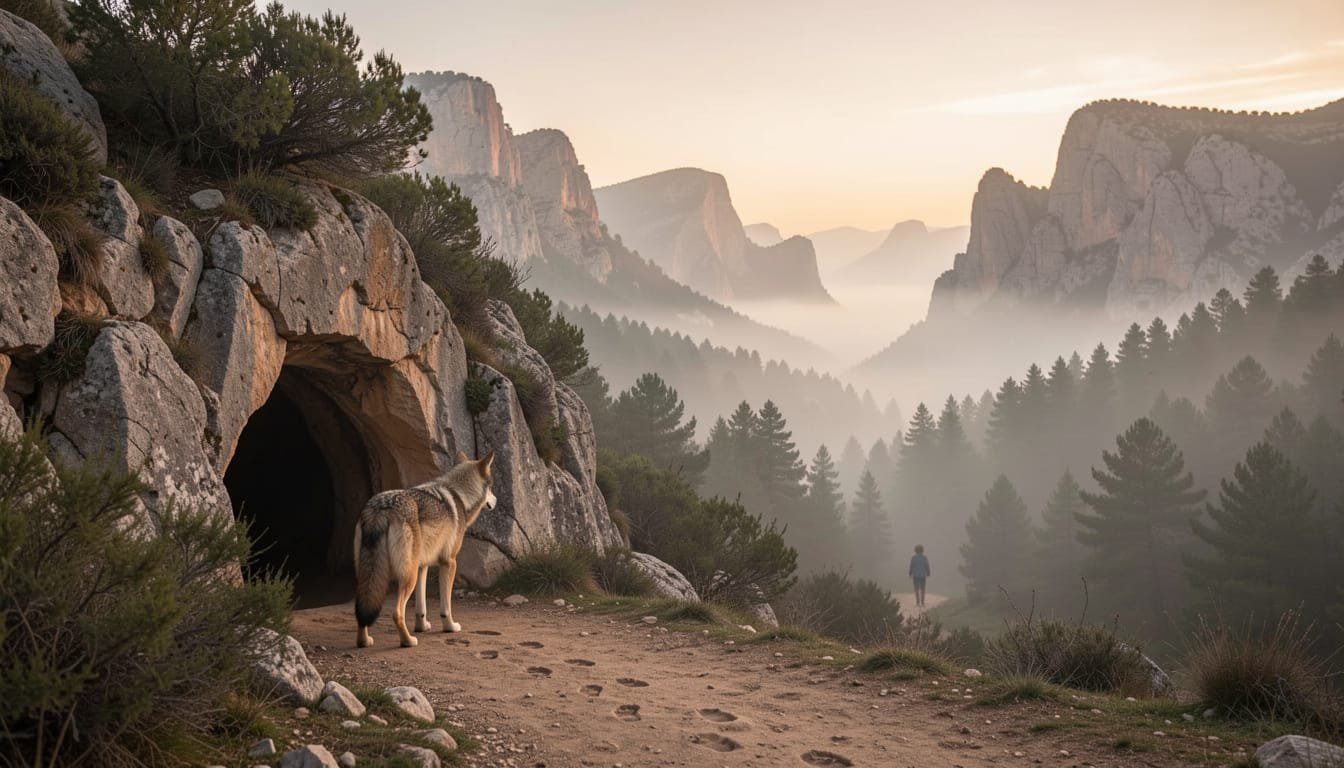
There’s a sentence buried in the tributes to Marcos Rodríguez Pantoja that I can’t stop turning over. A neighbour in the tiny Galician village where he spent his final decades called him “a person made of earth, wind, air, rain, and hunting dens.”
Not a person who loved the outdoors. Not a person who found peace in nature, the way we say about anyone who takes up allotment gardening in their fifties. A person made of it. Assembled from weather and soil the way the rest of us are assembled from Sunday roasts and school discipline and whatever else it is that turns a baby into an adult.
Marcos died on the 15th of August, aged 80, in the Ourense village of Rante, where he’d lived since 2001. And if you’ve never heard of him, buckle in, because this is one of those stories that makes the rest of us look faintly ridiculous for complaining about our commutes.
A Bad Start, Even by the Standards of 1946
He was born into Francoist Spain, a country that had just finished losing a civil war and was now watching the rest of Europe finish losing a world one. Poverty wasn’t a condition back then so much as a postcode. Rodríguez was born in the southern village of Añora, and after his mother’s death, his siblings went to live with relatives while he stayed with his father, who remarried and moved the family to the Sierra Morena mountains to make charcoal.
Other sources fill in the uglier edges. He was three when his mother died in childbirth. His father, not exactly father-of-the-year material to begin with, left him with a stepmother who treated him cruelly, and by the age of seven Marcos had been handed off entirely, given to an elderly goatherd living alone in the hills, essentially sold into a hermit’s apprenticeship because that was one fewer mouth to feed at home.
I want to sit with that for a second, because it’s the sort of detail that gets skated past in the “wolf boy” headlines. This wasn’t an adventure. This was a family disposing of an inconvenience. The wolves came later, and by comparison, they were the kind ones.
The Old Man in the Cave
The goatherd, whoever he was, at least seems to have been decent to the boy. He kept him warm in animal skins, taught him to milk goats, showed him how to snare rabbits with nothing but a stick and patience. Marcos later described their first meeting to a researcher: he was taken up into the mountains, to a cave, and “a little old man with a beard and cork shoes came out from there.”
It reads like the opening of a fairy tale. It was, in its way. Under the old man’s tuition Marcos learned what one academic who studied his case called “the law of the jungle.” He understood he was different from the animals around him, mostly, as he put it, because he had hands. But he still felt part of the world he was living in. He learned to speak in birdsong, in the cry of a deer, and came to believe he could talk, properly talk, with foxes and wolves and even snakes.
Then, around 1954, when Marcos was somewhere between seven and ten depending on which account you trust, the old man vanished. No explanation, no goodbye. Just gone, presumably dead, and a child left utterly alone in the Sierra Morena with nothing but a decade’s worth of half-taught survival skills.
Finding the Pack
What happened next is the part that made him famous, and it still doesn’t sound plausible even when five different news outlets are reporting the same core details.
He nearly died early on, eating meat from a diseased deer that made him violently ill. He taught himself to fish and forage properly after that. And then he found two wolf cubs in a cave and, having nothing else to do and nobody else to talk to, started visiting them daily to play.
One afternoon he fell asleep beside the cubs. He woke to a paw striking him and opened his eyes to find the mother wolf standing over him, and by his own account he was certain his short, strange life was about to end there. Instead, what followed felt to him like an induction ceremony. The male wolf returned with a deer carcass. The mother began doling out meat to her cubs. Hungry and bold, Marcos reached for a scrap from one of the pups and had it snatched straight back by the mother.
Then she offered him a piece herself.
I’ve read that paragraph about four times now and it still gives me a proper shiver. There’s something almost unbearably tender in it, a wild animal making a decision about a starving human child that most humans in his life hadn’t managed to make. He spent the better part of twelve years with that pack, sleeping in their den, learning to hunt and howl and warn them of danger, and by his own repeated admission, those were the best years of his life. He always said his happiest life was with the wolves, because he didn’t feel very comfortable with humans.
Read that line twice. It’s not a throwaway. It’s the whole thesis of the man.
Coming Back Was the Hard Part
At nineteen, Marcos was found and returned, forcibly, to human society. And this is where the story stops being a heartwarming wildlife documentary and turns into something closer to a tragedy, because integration very rarely works the way well-meaning institutions imagine it will.
He struggled. Of course he struggled. Imagine spending your entire developmental childhood without language, without money, without small talk, without the thousand invisible social rules the rest of us absorb before we’re old enough to remember absorbing them, and then being dropped into a Spanish village and told to get on with it. His story eventually reached a professor named Gabriel Janer Manila, who interviewed him extensively and turned the case into a PhD thesis, later a book, titled, rather beautifully, I Have Played with Wolves. In 2010 it became a film, Entrelobos, in which Marcos himself appeared as an advisor and briefly on screen, and which picked up two Goya nominations for its trouble.
By 2018, in an interview given decades after his “rescue,” he said he was disappointed in human nature and wished he could go back to the mountains and leave society behind entirely. I don’t think that’s a man being dramatic for a journalist. I think that’s a man who spent seventy years being scrupulously honest about which world had actually been good to him.
Rante
He eventually settled in the Galician hamlet of Rante in 2001, sharing a home for a time with a retired police officer, and later given a house outright by a fellow resident. Neighbours supported him properly, especially through two years of illness at the end. When he died, more than 300 people came to his funeral. The local council of San Cibrao das Viñas posted a tribute that I think is worth quoting in full because it’s better than anything I could write to replace it:
“Marcos arrived in Rante with a story that the world knew. He leaves, leaving here a story that is also ours.”
That’s proper writing, that. Council social media accounts don’t usually manage a line with that much grace.
Why This One Stuck With Me
I live off-grid myself these days, in a cave dwelling in rural Spain with a handful of friends who’d rather have quiet and hills than Wi-Fi and traffic. It’s not remotely the same thing, obviously. I chose mine. Nobody handed me to a goatherd. But there’s something in Marcos’s story that lands closer to home for me than the average news cycle curiosity, and it’s this: society has a very specific, very narrow idea of what a “recovered” life looks like, and it rarely stops to ask whether the person actually wants it.
We tell stories like this as triumph narratives. Boy raised by wolves, returned to civilisation, redeemed except Marcos never fully agreed with that framing, not once, not for seventy years. He kept saying, patiently, to anyone who’d interview him, that the wolves had been kinder than his own species. We kept publishing that quote as a fascinating detail rather than as the verdict it actually was.
He got his peace in the end, it seems. A village that took him in properly. Three hundred mourners. A tribute that called his story “ours” rather than something borrowed for a headline. That’s more than a lot of people get, wolf-raised or otherwise.
But I keep thinking about the cubs in that cave, and the mother wolf handing a starving boy a piece of meat that his own family never managed to offer him. Sometimes the wild thing is the safe one. Marcos Rodríguez Pantoja knew that better than anyone who’s ever lived, and he never once stopped saying so, even when nobody particularly wanted to hear it.