
There is something wonderfully unfashionable about an olive tree.
It does not care about your schedule, your productivity app, your five-year plan or the fact that you have decided that this is the year you are finally going to get your life organised. It simply stands there, often looking as though it has been mildly unimpressed by humanity for several centuries, quietly doing what olive trees do.
And then, eventually, there are olives.
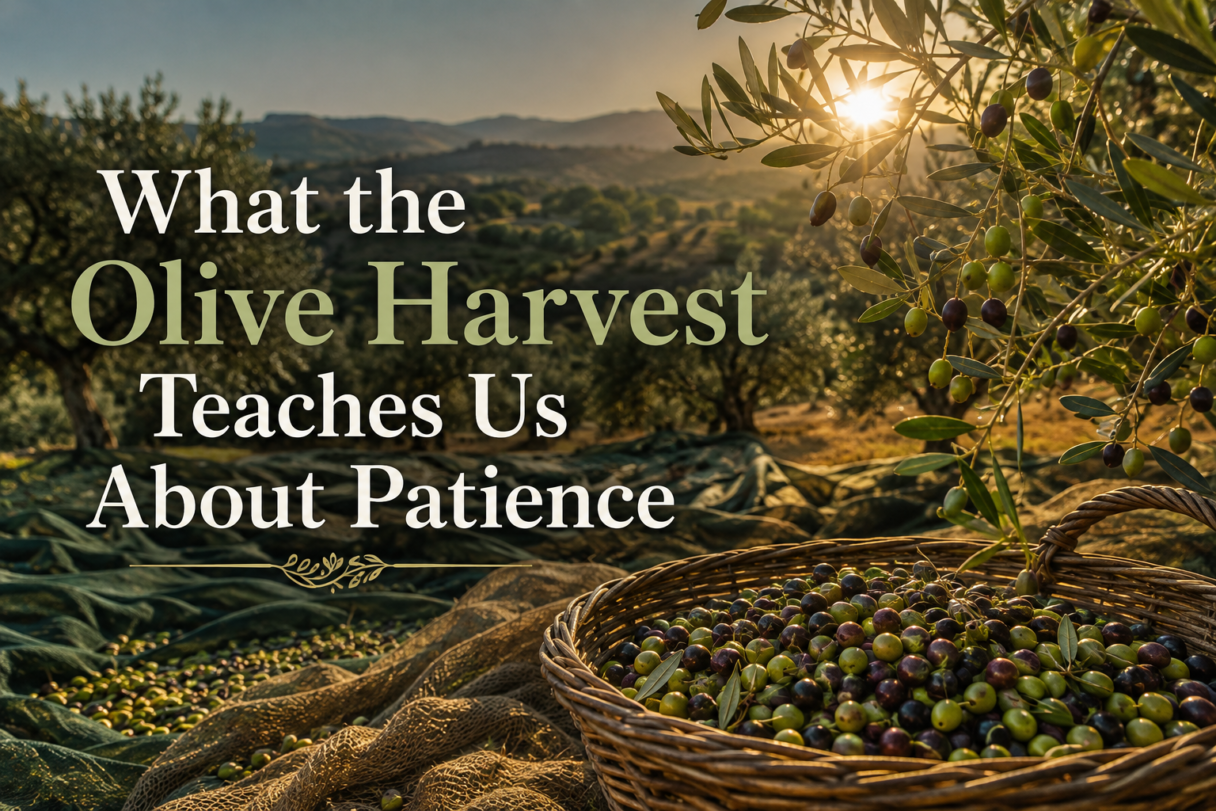
Living in Spain, particularly away from the cities and the coastal resorts, it is difficult not to become aware of the rhythm of the olive harvest. The landscape changes as the year moves on. The trees that have spent the long summer sitting beneath an unforgiving Andalusian sun begin to carry the promise of the season ahead. The fruit develops, changes colour and slowly reaches the point at which it can be gathered.
The important word there is slowly.
And perhaps that is one of the things the olive harvest teaches better than almost anything else… some things simply cannot be hurried.
The olive harvest is not a single event that happens because somebody has looked at a calendar and announced that today is Olive Day. Depending upon the variety, location and intended use of the fruit, harvesting can begin in autumn and continue into the winter months. Green olives destined for the table may be gathered earlier, while olives intended for oil are generally allowed to develop further before harvesting. In Andalucía, the traditional verdeo can take place from September into November, while oil-producing harvests commonly extend later into the season. (Andalucia)
The precise timing matters because the olive itself is changing. It is not merely sitting on the tree waiting for someone with a net and a stick to come along. Maturity affects the fruit, the oil it can produce and the character of the final result.
That means the person looking after the trees has to pay attention.
Not obsessively. Not frantically. Just attentively.
There is a rather profound difference between those things.
We live in an age that has become rather uncomfortable with waiting. We expect messages to arrive instantly, parcels to appear tomorrow, films to begin immediately, and answers to questions to be available within seconds. We have somehow managed to turn the loading wheel on a website into a minor personal insult.
The olive tree offers a rather different proposition.
Wait.
Watch.
Let the season develop.
There is something almost subversive about that.
The tree does not become more productive because somebody shouts at it. It does not respond to motivational slogans. It cannot be persuaded that it would really benefit from setting itself some ambitious quarterly objectives. It simply follows the conditions around it… the soil, the rain, the heat, the cold, the amount of sunlight and the passage of the seasons.
And eventually, when the time is right, the harvest begins.
That patience has traditionally been built into the work itself. In parts of Andalucía, olives have long been harvested by hand or with traditional methods such as ordeño, where the fruit is gently removed from the branches, while vareo involves shaking or striking the branches so that the olives fall onto nets or sheets beneath the trees. Modern machinery has changed much of the process, but the fundamental relationship between tree, season and harvest remains. (Andalucia)
The interesting thing is that patience does not mean doing nothing.
That is probably where we get the whole idea wrong.
Waiting for something to happen can sound passive, almost lazy. But anybody who has spent time around land knows that waiting properly requires attention. You prepare. You maintain things. You watch the weather. You notice changes. You make decisions when decisions need to be made, rather than because you are uncomfortable with uncertainty.
There is work involved in waiting for an olive harvest.
There is simply no guarantee that the work will produce an immediate result.
That distinction has become rather important in modern life.
We have grown accustomed to measuring almost everything by immediate outcomes. A business must grow. A website must perform. A social media post must engage. A garden must produce. A project must demonstrate progress. Even our hobbies have somehow acquired targets.
Yet the natural world remains stubbornly indifferent to our obsession with metrics.
An olive tree can spend years growing before it becomes properly productive. Some of the trees scattered across the Spanish landscape are older than the roads beside them, older than the houses around them and probably older than several generations of the families who tend them. Andalucía’s olive groves are not merely agricultural spaces… they are part of a landscape and culture that have developed over thousands of years. (Andalucia)
That changes the way you look at time.
When you sit beneath an old olive tree, the idea that everything needs to happen immediately begins to look slightly ridiculous.
The tree has survived summers, winters, droughts, storms, changing governments, changing fashions and probably several generations of people confidently explaining that everything was better in their day.
It is still there.
There is another lesson hidden in the harvest too, and it concerns knowing when to stop waiting.
Patience is not the same thing as endlessly postponing action. The farmer cannot simply say, “We’ll leave it another year and see what happens.” There comes a point when the fruit is ready, and the harvest needs to begin.
That requires judgement.
And perhaps that is the more useful lesson for the rest of us.
Patience is not about waiting forever. It is about learning to recognise the difference between something that is not ready and something that we are simply afraid to begin.
That can be surprisingly difficult.
Sometimes we act too soon because we are impatient. We pick the fruit while it is still developing because we want the satisfaction of having done something. Other times we wait too long because waiting feels safer than making a decision.
The olive harvest sits somewhere between those extremes.
You prepare, you observe and then, when the conditions are right, you act.
There is something wonderfully practical about that philosophy.
It applies to houses, gardens, businesses, relationships, writing and perhaps even the decision to move somewhere quieter and simpler. Anyone who has ever bought an old property in rural Spain will understand that the phrase “it just needs a little work” can conceal an adventure of almost military proportions.
You learn fairly quickly that not everything needs to be fixed today.
Some things need fixing immediately.
Some things can wait until tomorrow.
Some things will reveal that they were never actually a problem in the first place.
The countryside has a way of teaching that distinction.
It also teaches us that the reward for patience is not always spectacular. Sometimes it is something remarkably ordinary… a bottle of good olive oil, a meal eaten outside, bread dipped into something you know came from trees growing a few kilometres away.
That may sound like a small thing.
Perhaps it is.
But small things are often where a life actually happens.
The modern world has become rather good at convincing us that satisfaction must arrive in large packages. We are encouraged to chase bigger houses, bigger holidays, bigger incomes, bigger audiences and increasingly complicated versions of happiness.
Meanwhile, somebody is harvesting olives.
They are gathering fruit from a tree that has been quietly producing its crop while the rest of us were busy checking our phones.
There is a certain humility in that.
Perhaps this is one reason rural life can feel so different from the life many of us have become accustomed to. It puts us back into contact with processes that have no interest in our impatience. Bread needs time to rise. Wood needs time to dry. Gardens need seasons. Buildings need maintenance. Food needs preparation. Trees need years.
And people, inconveniently, need time too.
We are not machines, although modern society occasionally seems determined to test that proposition.
There are periods in life when nothing appears to be happening. We look at our circumstances and wonder whether we have made the wrong decisions, whether we should be doing more, whether everybody else is somehow moving ahead while we are standing still.
The olive tree might offer a different interpretation.
Perhaps standing still is not always the same as doing nothing.
Perhaps some of the most important things are happening beneath the surface, where they cannot yet be seen.
The fruit is developing.
The roots are doing their work.
The season is moving.
And eventually, if we have paid enough attention, there comes a moment when we know it is time to gather what has grown.
That is a rather useful thing to remember when life feels frustratingly slow.
Not everything that takes time is failing.
Sometimes it is simply ripening.
And perhaps that is what the olive harvest really teaches us. Not merely patience, but proper patience… the kind that combines preparation with observation, effort with restraint and action with the willingness to wait until the moment is right.
Out here, the trees have been practising it for centuries.
It seems only polite that we should pay attention.