
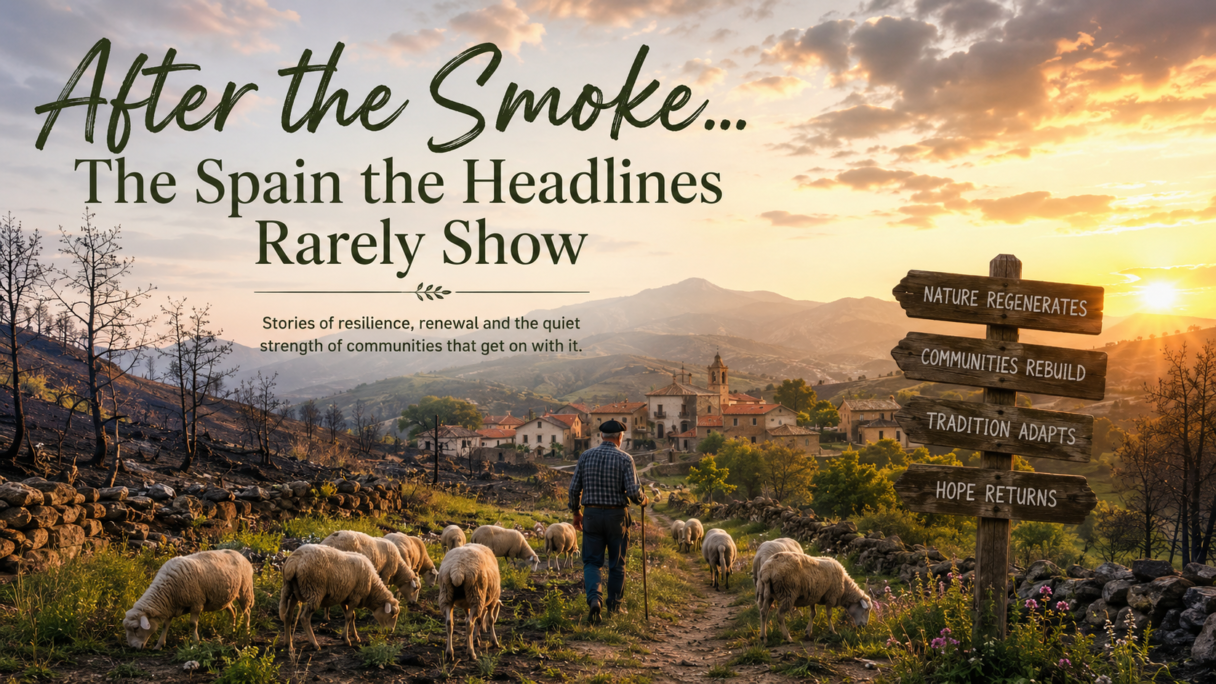
For much of this summer, the images have been impossible to ignore. Hillsides engulfed in flames. Villages evacuated with little more than the clothes people happened to be wearing. Firefighters working through the night beneath skies glowing an unsettling shade of orange. Across Spain, Portugal, France, Greece and other parts of southern Europe, wildfires have once again dominated the news, leaving behind scorched landscapes and communities facing an uncertain future. It is a familiar story, and one that never becomes any easier to watch.
The news has a habit of lingering where the drama is greatest. Cameras naturally gravitate towards the flames, the helicopters, the exhausted emergency crews and the heartbreaking stories of people who have lost homes, businesses or livelihoods. Those stories deserve to be told.
Yet what the headlines rarely return to show is everything that happens afterwards.
The television crews move on. The breaking news banners disappear. Public attention shifts to the next crisis. Meanwhile, life quietly begins again.
Living in rural Spain has taught me that resilience is rarely loud. It doesn’t announce itself. It doesn’t arrive accompanied by politicians or television presenters. More often, it arrives with neighbours carrying wheelbarrows, café owners putting tables back outside, farmers checking fences and families sweeping ash from doorsteps before the first customers arrive.
That is the Spain I have come to admire.
It is easy, particularly for those living outside the country, to imagine Spain simply as sunshine, beaches and endless holidays. Those of us who actually live here know a rather different Spain. It is a country of remarkable landscapes, ancient forests, mountain villages, olive groves, almond orchards and communities that have learned, over generations, how to adapt to a climate that has never been entirely predictable.
Fire is not new here.
That does not make it any less devastating, nor should it lessen our concern as hotter summers become increasingly common. But understanding Spain also means understanding that its people have lived alongside this landscape for centuries. They know that nature has its own rhythms… and that recovery often begins long before anyone notices.
One of the remarkable things about Mediterranean ecosystems is that they evolved with fire as part of their natural cycle. Certain pine cones only release their seeds after intense heat. Shrubs such as rockrose, rosemary and thyme often begin regenerating surprisingly quickly. Winter rains wash nutrients back into the soil. What appears, at first glance, to be lifeless black earth often conceals the beginnings of new growth waiting patiently beneath the surface.
Nature, unlike people, never seems to panic.
It simply gets on with the business of living.
There is perhaps a lesson in that.
We often imagine resilience as something dramatic. We picture grand acts of courage, heroic speeches or extraordinary sacrifices. In reality, resilience usually looks rather ordinary. It is found in the daily routines that quietly continue despite everything that has happened.
The village bakery opens again.
The local market returns.
Someone repairs a dry-stone wall.
Children cycle through streets that only weeks before were filled with emergency vehicles.
Life, almost stubbornly, insists on carrying on.
One recent story from Galicia caught my attention because it perfectly captures this spirit of adaptation. Faced with the growing threat of wildfires, some communities are turning not to cutting-edge technology but to practices that would have been entirely familiar to previous generations.
Native sheep and cattle are once again being encouraged to graze woodland and scrubland. Their job is wonderfully uncomplicated. They eat the grasses, shrubs and undergrowth that, left untouched, become the perfect fuel for future fires. Instead of expensive machinery clearing vast areas of vegetation, the animals do what they have always done naturally.
It is an old solution, finding a new purpose.
There is something quietly reassuring about that. At a time when so many conversations revolve around artificial intelligence, drones and increasingly sophisticated technology, here is a reminder that progress does not always mean replacing the past. Sometimes it means rediscovering the wisdom we already possessed.
The shepherd, it turns out, may be every bit as important as the scientist.
Perhaps more importantly, this approach does more than reduce fire risk. It supports rural livelihoods, preserves native breeds, maintains biodiversity and strengthens communities that have often struggled against depopulation for decades.
One simple idea manages to solve several problems at once.
That feels like intelligent living.
It also reflects something I have increasingly noticed during my years in Spain. Solutions here are often practical before they are fashionable. They emerge because someone simply asks, “What works?” rather than “What looks impressive?”
That may explain why village life continues to appeal to me.
Away from the noise of cities and social media, people remain surprisingly good at solving problems together. The person with a tractor helps clear debris. The neighbour with a chainsaw lends a hand. Someone produces sandwiches. Someone else puts the kettle on. Nobody particularly waits to be asked.
There is no committee.
No strategy document.
No viral campaign.
Just people quietly doing what communities have always done.
Perhaps that is why the stories rarely make national headlines. Quiet competence isn’t especially exciting. It doesn’t generate endless television debates or dramatic social media clips. It simply works.
The irony is that these quieter stories often tell us far more about a country than the disasters ever can.
Spain is sometimes portrayed internationally as fragile in the face of climate change. Certainly, the challenges are real. Summers are becoming hotter. Rainfall patterns are changing. Rural depopulation has left some landscapes less actively managed than they once were. These are serious issues requiring thoughtful long-term solutions.
Yet it would be a mistake to underestimate the adaptability of the people who live here.
Generations have learned how to work with difficult landscapes rather than constantly trying to dominate them. Terraces were built by hand. Water was carefully stored. Crops were selected because they could survive long periods without rain. Livestock grazed where machinery could never reach.
Long before sustainability became a fashionable word, people simply called it common sense.
Modern Spain is increasingly rediscovering some of those lessons.
None of this diminishes the sadness of seeing forests burn or families lose their homes. Compassion demands that we acknowledge both the human cost and the environmental consequences. But hope also deserves a place in the conversation.
Hope is not naïve optimism.
Hope is watching green shoots emerge from blackened ground.
Hope is seeing neighbours rebuilding together.
Hope is recognising that recovery begins long before perfection returns.
Living in rural Andalucía, I have come to appreciate just how patient nature really is. Seasons still arrive whether we worry about them or not. Almond trees blossom when they are ready. Swallows return without checking the headlines. Rain eventually falls. The landscape slowly reshapes itself.
Perhaps we could learn something from that rhythm.
Our modern world encourages us to think in news cycles measured by hours or days. Nature measures time rather differently. A hillside damaged this summer may look remarkably different by next spring. A woodland that appears lost forever can, given enough care and patience, begin writing an entirely new chapter.
The cameras are rarely there to witness it.
Maybe that is why those of us fortunate enough to live here have a responsibility to tell these quieter stories ourselves. Not to ignore the tragedies, nor to pretend everything is fine, but to remind people that resilience exists alongside heartbreak.
Both can be true.
When the smoke eventually clears, what remains is not simply a scarred landscape. It is a community finding its feet once more. It is old knowledge being rediscovered. It is neighbours helping neighbours because that is simply what decent people do. It is farmers walking fields, shepherds guiding their flocks, café owners unlocking their doors and children returning to play where silence briefly replaced laughter.
That Spain rarely leads the evening news.
Perhaps it should.
Because beyond the dramatic images that capture our attention lies something far more enduring… the quiet determination of ordinary people and the remarkable ability of both nature and humanity to begin again.
Until Next Time