
Ho, Ho… Hang On a Minute
The first Christmases I remember with any clarity were not British ones. As a forces kid, I collected festive seasons the way other children collected stamps, and so my early Decembers came with a German accent: Advent calendars, the hot wine fug of a market square, and a stern bearded bishop who turned up on the sixth of December to check whether I had been good. Later came Oslo, where the sun clocked off at about three in the afternoon and every window in the street held a candle against the dark. Then Hull, where Christmas meant the Queen’s speech, a turkey the size of a small dog, and a paper crown that never once stayed on anybody’s head.
These days I write this from a cave in rural Spain, which is not a sentence I expected to type when I was polishing my boots in the RAF Police. My Spanish neighbours, bless them, think the British way of doing things is faintly ridiculous. They are not wrong. They also keep a log in the corner that they beat with sticks until it defecates sweets, so I would gently suggest that nobody in Europe is in a position to judge anybody else.
That, really, is the point of this piece. We talk about “Christmas” as though it were one thing, a single glossy product shipped from a warehouse somewhere near Lapland, with a jolly man in red attached. It isn’t. Europe has dozens of Christmases, some of them devout, some of them pagan with a light coat of tinsel, and a few of them frankly terrifying. Gift givers arrive on different dates, by different routes, with different moral standards. The main meal might be on the twenty fourth, the twenty fifth, or the seventh of January. In some places the children are visited by a saint, in others by a witch, and in at least one by a cat that eats you if you don’t have new clothes.
So pour yourself something warm, pull your chair a little closer to the fire (or in my case, the wood burner wedged into a rock wall), and let’s take a slow, nosy wander across the continent to see how the neighbours really do it.
Saints, Wreaths and Wooden Huts: The Season Starts Early
If you’re British, Christmas tends to arrive in one great lump on the twenty fifth, preceded by six weeks of adverts and a growing sense of dread about the in-laws. Across much of the continent, the season unfolds more slowly, in instalments, and the first proper visitor isn’t Father Christmas at all. It’s his older, more serious relative, Saint Nicholas, the fourth century bishop of Myra, who is remembered on the sixth of December and who still does the rounds in a mitre and a red cloak, carrying a crozier and an expression that suggests he has read your file.
In the Netherlands and Flanders he goes by Sinterklaas, and the Dutch take him very seriously indeed. He arrives by steamboat from Spain in mid November (nobody has ever satisfactorily explained why a Turkish bishop lives in Spain, and frankly the Dutch don’t seem bothered), parades through town on a white horse, and then spends the next three weeks filling children’s shoes with sweets and chocolate letters. The big night is the fifth of December, pakjesavond, when the presents come out along with rhyming poems that gently, or not so gently, roast the recipient. His helpers, the Pieten, have been the subject of a long and bruising national argument over the blackface tradition, and these days many towns have switched to “soot-smudged” Piets who got their marks from coming down the chimney. It’s a reminder that even the cosiest traditions get dragged, sometimes kicking, into the present.
Germany, meanwhile, gave the world two inventions that most of us now take entirely for granted. The Advent wreath, with its four candles lit one Sunday at a time, is usually credited to a Hamburg pastor named Johann Hinrich Wichern, who in the 1830s rigged up a cartwheel of candles so the children in his care could count down the days. The Advent calendar followed in the same spirit, though its descendants have rather lost the plot… I’ve seen ones for adults that hide gin, cheese, and in one alarming case, socks. As a small boy in Germany, I had the paper kind with a picture behind each door, and I can confirm that the excitement of discovering a drawing of a robin on the twelfth of December has never quite been matched by anything I’ve unwrapped since.
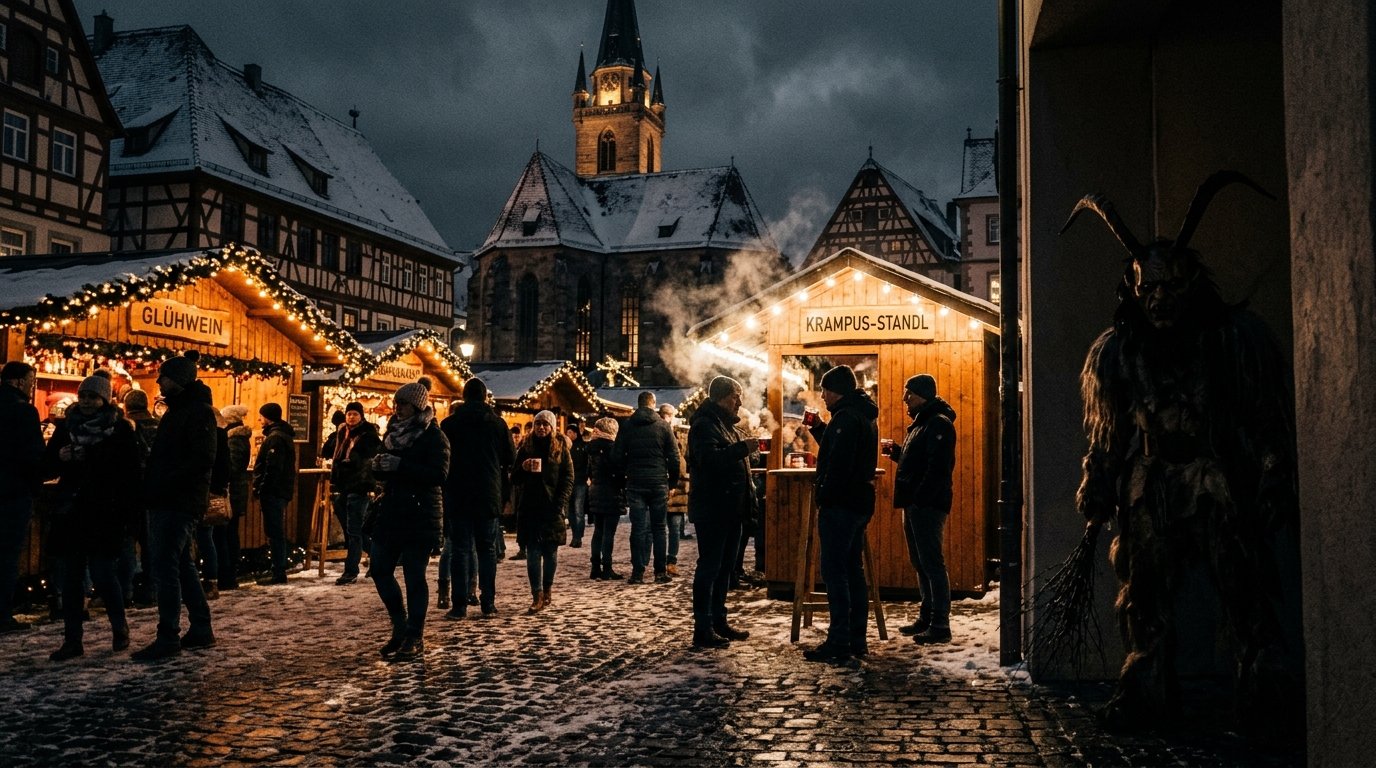
And then there are the markets. The German Weihnachtsmarkt is the template for every wooden hut selling overpriced mulled wine from Manchester to Malmö, but the originals are something else. Dresden’s Striezelmarkt has been trading since 1434, and Nuremberg’s Christkindlesmarkt is opened each year by a young woman dressed as the Christkind, a golden-haired angelic figure who, in much of southern Germany, Austria and Switzerland, is the one who actually brings the presents on Christmas Eve. You stand in the cold with your hands wrapped around a mug of Glühwein, the air thick with roasted almonds, bratwurst and pine, and for a moment the whole commercial circus feels oddly innocent. Then you realise you’ve paid a five euro deposit on the mug and have no intention of giving it back, and the spell is broken, but pleasantly so.
The Naughty List Has Teeth: Krampus and Friends
Here’s something the greetings card industry would rather you didn’t know. For most of European history, the bringer of presents did not travel alone. He came with muscle. Saint Nicholas might hand out the oranges and gingerbread, but somebody had to deal with the children who had been, shall we say, less than angelic, and that job fell to a whole rogues’ gallery of enforcers who would make a modern safeguarding officer reach for the smelling salts.
The most famous of them is Krampus, the horned, hairy, long-tongued demon of the Alps. In Austria, Bavaria, South Tyrol and parts of Slovenia and Hungary, the evening of the fifth of December is Krampusnacht, when young men in hand-carved wooden masks and shaggy goatskin suits stomp through the streets rattling chains and cowbells and swiping at onlookers with bundles of birch twigs. The Krampuslauf, or Krampus run, is part street theatre, part rite of passage, and part excuse for a lot of schnapps. Tradition held that the truly wicked child would be bundled into a basket on Krampus’s back and carried off, destination unspecified. As someone who spent a career dealing with people who’d been bundled into the back of things, I find it a refreshingly honest approach to behavioural management.
He has cousins all over the place. In Germany there’s Knecht Ruprecht, a dark, ragged farmhand figure who carries a sack and a stick. In Alsace and Lorraine, Saint Nicholas is shadowed by Père Fouettard, literally “Father Whipper”, whose name rather gives the game away. In the Czech Republic and Slovakia, Mikuláš walks the streets on the eve of his feast with two companions, an angel and a devil, a sort of good cop, bad cop arrangement with eternal consequences. Children are expected to recite a poem or sing a song, and the devil, rattling his chains, makes sure the effort is sincere.
And then there’s Perchta, the Alpine witch-goddess who patrols the twelve days of Christmas. Depending on which grandmother you ask, she rewards the hardworking with a silver coin and punishes the lazy by slitting open their bellies and stuffing them with straw and pebbles. In the Salzburg region and the Tyrol, the Perchtenlauf still sees masked figures, some beautiful and some grotesque, parading in January to drive out the spirits of winter. It’s the kind of thing that makes you realise how thin the Christian veneer on the midwinter festival really is. Strip away the carols and you find something much older underneath, a people huddled against the longest nights, frightening the darkness away by becoming, for one night, the most frightening thing in it.
Candles, Brooms and a Duck Called Kalle: The Nordic Christmas
If you want to understand why the Scandinavians are so good at Christmas, spend a December in Oslo. By mid afternoon it’s dark, properly dark, and it stays that way until well after breakfast the following morning. In that context, a festival of light isn’t a nice idea, it’s a survival strategy. Every window glows with candles or a seven-armed electric candlestick, and the whole region seems to agree, without ever saying so, that the only sane response to the long night is to make everything as warm, bright and buttery as humanly possible.
The season really begins on the thirteenth of December with Saint Lucia’s Day, celebrated across Sweden and in much of Norway and Finland. Before dawn, a girl in a white gown, a red sash and a crown of candles (real ones, traditionally, which has never struck me as the safest place to keep a naked flame) leads a procession of attendants singing the haunting Lucia song, handing out saffron buns called lussekatter and ginger biscuits. Schools, offices, care homes and churches all hold their own processions. It’s one of the loveliest things I know, and also one of the few occasions when a Swede will cheerfully set their own hair on fire for the sake of tradition.
Norway has its own magnificent oddities. On Christmas Eve, when the main celebration takes place after the church bells “ring in” Christmas at five o’clock, many households still hide their brooms, because folklore has it that witches and evil spirits come out on that night looking for something to fly on. I never saw a witch during my Oslo years, which I suppose proves it works. Dinner is usually ribbe, roast pork belly with crackling, or pinnekjøtt, salted and dried lamb ribs steamed over birch twigs, while the brave go for lutefisk, dried cod soaked in lye until it achieves the consistency of a disappointing jelly. A bowl of rice porridge is often left out for the nisse, the small bearded farm gnome who, if neglected, will play tricks on the household. Across the border in Denmark, an almond is hidden in the Christmas rice pudding, and whoever finds it wins a marzipan pig, which tells you everything you need to know about Danish priorities.
Sweden, meanwhile, has achieved something truly extraordinary. At three o’clock every Christmas Eve, the nation sits down in front of the television to watch Kalle Anka och hans vänner önskar God Jul, “Donald Duck and His Friends Wish You a Merry Christmas”, a collection of Disney cartoons from the 1930s to the 1950s that has been broadcast at the same hour every year since 1960. It routinely draws around 40 per cent of the population, and in 2020 more than 4.5 million Swedes tuned in, almost half the country. Calls to the emergency services reportedly drop by about a fifth while it’s on. Nobody eats, nobody cooks, and woe betide the visiting foreigner who suggests they could just stream it later. The town of Gävle, for its part, builds a thirteen metre straw goat every Advent, and a remarkable number of years somebody sets fire to it. The goat has its own social media following. Nobody has ever fully explained any of this to me, and I’ve stopped asking.
Finland adds its own quiet dignity to the mix. At noon on Christmas Eve, the Declaration of Christmas Peace is read out in the old capital of Turku, a tradition stretching back to the Middle Ages, and broadcast to the nation. Then it’s off to the sauna, and in the evening many families visit cemeteries to leave candles on the graves of loved ones, so that the snow-covered churchyards glitter in the dark. It’s one of the most moving sights in Europe.
And then there’s Iceland, which takes the Nordic flair for the uncanny and turns it up to eleven. Icelandic children aren’t visited by one Santa but by thirteen, the Yule Lads, troll brothers who come down from the mountains one per night from the twelfth of December. They have names like Spoon Licker, Door Slammer, Sausage Swiper and the deeply unsettling Window Peeper, and they leave small gifts in shoes on windowsills, or a rotten potato if you’ve misbehaved. Their mother, Grýla, is an ogress who boils naughty children in a cauldron, and their pet, the Yule Cat, eats anyone who hasn’t received new clothes before Christmas. All of which is balanced, thank heavens, by Jólabókaflóð, the Christmas Book Flood, the custom of giving books on Christmas Eve and spending the night reading in bed with chocolate. As a writer, I can only say that if I’m ever reincarnated, I’d like to come back as an Icelandic paperback in December.
The First Star, the Empty Chair and the Carp in the Bath: Central and Eastern Europe
Travel east and the emphasis shifts from the day itself to the evening before. In Poland, Christmas Eve, Wigilia, is the heart of the whole affair, and it doesn’t officially begin until somebody, usually the youngest child, spots the first star in the evening sky. Only then can the family sit down. Before eating, everyone shares the opłatek, a thin white wafer embossed with a nativity scene, breaking off a piece from each other’s and exchanging wishes for the year ahead. It’s a small ritual that tends to make grown men go a bit misty, myself included, and I’m not even Polish.
The Wigilia table is traditionally meat free and, in many families, carries twelve dishes, one for each apostle: beetroot soup with tiny mushroom dumplings, pierogi, herring in its many guises, and poppy seed cake. A wisp of hay is often tucked under the tablecloth in memory of the manger. And there is always one extra place set, for the unexpected guest, the lonely traveller, or the family member who can’t be there. I’ve always thought that empty chair says more about the spirit of Christmas than any amount of tinsel. It’s an open door, laid out in cutlery.
Then there’s the carp. In Poland, the Czech Republic and Slovakia, carp is the centrepiece of the Christmas Eve meal, and in a fine old tradition that is now slowly fading, the fish is bought live a few days early and kept in the family bathtub until its appointment with destiny. Generations of Central European children have grown up sharing their bath water with dinner, naming it, and then weeping inconsolably on the twenty fourth. A scale from the fish is often kept in the wallet for the coming year to bring prosperity. The Czechs also cut an apple crosswise at the table, and if the core forms a perfect star, the year ahead will be a healthy one. Unmarried women might throw a shoe over their shoulder towards the door; if the toe points outwards, they’ll be married and gone within the year. In the Czech lands and Hungary, by the way, the presents are brought not by Santa but by baby Jesus himself, Ježíšek or Jézuska, who manages it without ever being seen.
Ukraine keeps one of the richest Christmas Eve traditions of all, Sviat Vechir or Holy Evening, with its own twelve meatless dishes led by kutia, a sweet porridge of wheat berries, poppy seeds, honey and nuts, and a sheaf of wheat called the didukh standing in the corner to honour the ancestors. Ukraine also gave the world one of its best-loved carols, though few people realise it. “Carol of the Bells” began life as Shchedryk, a Ukrainian folk song arranged by the composer Mykola Leontovych. For a century, Ukrainians celebrated Christmas on the seventh of January alongside Russia, but in 2023 the Orthodox Church of Ukraine moved to the Revised Julian calendar and parliament made the twenty fifth of December the official holiday, a decision widely read as a deliberate step away from Moscow. Not every parish has followed, and some families still keep both dates, but the shift tells you how deeply Christmas is tangled up with identity in that part of the world.
Elsewhere in the Orthodox world, the seventh of January still holds. In Serbia, on Christmas Eve (the sixth of January), families bring in a young oak branch or log, the badnjak, and burn it, a ritual with roots far older than the church, while on Christmas Day a round loaf called česnica is broken at the table with a coin baked inside for whoever gets lucky. Romania, Bulgaria and Greece celebrate on the twenty fifth, and Romania in particular keeps alive a wonderful tradition of carolling, colindat, where groups go from house to house singing, sometimes accompanied by a dancer in a goat costume, and are rewarded with cakes, fruit and, increasingly as the night wears on, plum brandy.
Lottery Tickets, Grapes and a Log That Poos Presents: Christmas in Spain
I’ll admit to some bias here, given that I’m writing from a hole in a Spanish hillside, but nobody does a long Christmas quite like Spain. It doesn’t really start until the twenty second of December and it doesn’t really finish until the sixth of January, and in between there is more eating, more family, more noise and more sheer sociable stamina than a quiet Englishman can comfortably process.
The starting gun is El Gordo, “The Fat One”, the Christmas lottery that has been drawn every twenty second of December since 1812, when it was dreamed up in Cádiz to help fund the fight against Napoleon. It is, by total prize money, the biggest lottery on Earth, with a pot of around 2.7 billion euros, and the vast majority of Spaniards take part, usually by sharing tickets with family, colleagues, the bar on the corner and the woman who runs the bakery. The numbers are sung out, in an eerie, rhythmic chant, by children from Madrid’s San Ildefonso school, and the draw runs for hours on national television. Entire villages occasionally win together, and the footage of people spraying cava over each other in the street is one of the great annual sights of Spanish life. The rest of us, of course, lose, and console ourselves with the thought that at least we have our health. It’s the most Spanish of traditions: communal, hopeful, slightly chaotic and almost entirely dependent on luck.
The main event for most families is Nochebuena, Christmas Eve, a long, loud dinner that starts late and finishes later, often with seafood, roast lamb or suckling pig, and mountains of turrón, the almond nougat that comes in hard Alicante and soft Jijona varieties and inspires fierce loyalties. The devout head to the Misa del Gallo, the Rooster’s Mass, at midnight. Christmas Day itself is, by comparison, a gentle affair of leftovers and recovery. On the twenty eighth comes the Día de los Santos Inocentes, Spain’s answer to April Fool’s Day, when newspapers print fake stories and children stick paper figures on the backs of unsuspecting adults. And on New Year’s Eve the whole country gathers to eat twelve grapes, one on each stroke of midnight, a ritual that sounds charming until you try it and realise you’re attempting to swallow a fruit every three seconds while laughing, which is, in my professional opinion, a choking hazard.
But the real gift giving, for most Spanish children, happens on the sixth of January, the Epiphany, when the Three Kings, los Reyes Magos, arrive. On the evening of the fifth, every town and village holds a cabalgata, a parade of floats from which the Kings and their pages hurl sweets at the crowd with an enthusiasm that borders on the military. Children leave out their shoes, along with water or milk for the camels, and wake to find presents. Breakfast is roscón de reyes, a ring-shaped sweet bread studded with candied fruit and concealing a tiny figurine and a dried bean. Find the figurine and you’re king for the day. Find the bean and you pay for next year’s roscón. There’s a lesson about life in there somewhere.
Then there’s Catalonia, where things get gloriously scatological. Every Catalan household worth its salt has a Tió (affectionately called Caga Tió, which translates roughly as “poo log”), a hollow log with a painted smiley face, little legs and a red cap, tucked under a blanket. Through December the children “feed” it scraps and keep it warm, and on Christmas Eve or Christmas Day they beat it with sticks while singing a song encouraging it to, well, relieve itself. When the blanket is lifted, the log has “produced” sweets, turrón and small gifts. Catalan nativity scenes, meanwhile, include the caganer, a little figure of a peasant in a red cap, trousers round his ankles, squatting discreetly behind the stable. These days you can buy caganers of footballers, politicians and royals, which I suspect is the most honest form of political commentary in Europe. The Basques, not to be outdone, have their own gift bringer, Olentzero, a pipe-smoking, wine-loving charcoal burner who comes down from the mountains on Christmas Eve. Spain, it turns out, doesn’t so much have a Christmas tradition as a federation of them.
Witches, Thirteen Desserts and Goblins in the Chimney: The Mediterranean Christmas
Italy, as you’d expect, organises Christmas around the table and the family, in that order. The big meal for many, particularly in the south, is the Vigilia on Christmas Eve, traditionally meatless and therefore heavy on fish: fried baccalà, eels, clams, calamari, the whole contents of the Mediterranean on a single overloaded tablecloth. Italian Americans have rebranded it the Feast of the Seven Fishes, a name that would puzzle most nonnas in Calabria, who simply call it dinner. Then comes the great national schism of Italian Christmas: panettone, the tall domed fruit bread from Milan, or pandoro, the golden star-shaped sponge from Verona. Families have been divided by less. In Naples, an entire street, Via San Gregorio Armeno, is given over year-round to artisans making nativity figures for the presepe, and alongside the shepherds and wise men you’ll find pizza makers, footballers and, inevitably, whichever politician has most annoyed the nation that year.
But the real star of the Italian season arrives late. On the night of the fifth of January, La Befana, an old woman on a broomstick, flies over the rooftops and climbs down chimneys to fill children’s stockings with sweets, or with coal if they’ve misbehaved (these days the coal is usually black sugar, because Italian grandmothers are softies at heart). Legend has it that the Three Kings stopped at her house to ask the way to Bethlehem and invited her along, but she was too busy sweeping. She’s been searching for the Christ child ever since, giving gifts to every child she finds just in case. There’s something rather moving about a Christmas figure defined by a missed opportunity and a lifetime of trying to make up for it. I suspect many of us can relate.
In France, the evening of the twenty fourth brings the Réveillon, a long, indulgent dinner of oysters, foie gras, smoked salmon, roast capon or turkey, and the bûche de Noël, a chocolate log cake that is essentially a Swiss roll in fancy dress. Provence goes further, with the gros souper, a meatless Christmas Eve supper followed by the famous treize desserts, thirteen desserts representing Christ and the twelve apostles: dried figs, almonds, raisins and walnuts (the “four beggars”, representing the monastic orders), nougat both black and white, fresh fruit, candied fruit, and a sweet olive oil bread called pompe à l’huile. They stay on the table for three days. Provence also gave us the santons, little hand-painted clay figures that populate nativity scenes with the whole village: the baker, the fishwife, the knife grinder, the village idiot. Then, at Epiphany, the French slice a galette des rois, a puff pastry tart filled with almond cream and hiding a small charm, the fève. Whoever finds it gets a paper crown and, in my experience, a chipped tooth.
Portugal keeps Christmas Eve as the Consoada, a family supper built around the nation’s beloved salt cod, bacalhau, boiled with potatoes, cabbage and eggs and drowned in good olive oil, followed by midnight Mass and a wealth of fried sweets. In parts of the north, an old custom saw the table left laid overnight after the meal, so that the souls of departed relatives could come home and share in the feast. It’s the Portuguese cousin of the Polish empty chair, and between them they say something important: that Christmas, at its best, makes room for those who aren’t there.
And then there’s Greece, where the twelve days of Christmas come with their own infestation. According to folklore, the kallikantzaroi, mischievous goblins who live underground and spend the year trying to saw through the tree that holds up the world, come to the surface between Christmas and Epiphany to cause havoc, curdling milk, creeping down chimneys and generally making a nuisance of themselves. Families kept the hearth fire burning day and night to keep them out. When they return underground at Epiphany, they find the world tree has healed itself, and they have to start sawing all over again, which is the most accurate description of public sector reform I’ve ever heard. Greek children go from door to door singing the kalanta, the traditional carols, and on islands and in harbour towns you’ll often see a lit and decorated wooden boat, the karavaki, alongside or instead of a Christmas tree, a nod to a seafaring nation’s long relationship with the waves. Gifts traditionally come on New Year’s Day from Saint Basil, and the vasilopita cake is cut with a coin hidden inside. On Epiphany, priests across the country throw a cross into the sea, a river or a harbour, and young men leap into the freezing water to retrieve it, earning a blessing for the year. Anyone who has dipped so much as a toe in the Med in January will tell you they’ve earned it.
Crackers, Pantomime and a Horse’s Skull at the Door: Britain and Ireland
It’s only fair, having poked fun at everybody else, to turn the spotlight on my own lot. Seen from a Spanish cave, the British Christmas is a thoroughly peculiar thing. We sit around a table in paper crowns, having pulled apart a cardboard tube that went bang, reading jokes so bad they’d be confiscated in any other context. The Christmas cracker was invented in the 1840s by a London confectioner called Tom Smith, who started out wrapping sweets in twists of paper and eventually added the snap, the hat and the motto. We have been groaning at the mottos ever since. The meal itself, roast turkey with all the trimmings, Brussels sprouts nobody admits to liking, and a Christmas pudding doused in brandy and set alight, is followed at three o’clock by the monarch’s Christmas broadcast, a tradition begun by George V on the radio in 1932. In my Hull childhood, the Queen’s speech was non-negotiable. You could be dozing in a turkey coma, but you had to be dozing within sight of the telly.
Then there is pantomime, which is almost impossible to explain to a foreigner without sounding unwell. Every December, theatres up and down the country stage loose adaptations of fairy tales in which the hero is played by a young woman, the comic old lady (the Dame) is played by a middle-aged man in an increasingly unhinged series of frocks, and the audience is expected to shout “He’s behind you!” and “Oh no it isn’t!” on cue. It’s anarchic, vulgar, and wonderful, and it’s where most British children first learn that the grown-ups are, at heart, quite silly. Boxing Day, the twenty sixth, brings football, long walks, cold turkey sandwiches and, for the hardy, a dip in a freezing sea or lake, usually in fancy dress, usually for charity, always regretted.
The four nations each keep their own flavour. Scotland, thanks to the long shadow of the Reformation, didn’t even make Christmas Day a public holiday until 1958, and for centuries the real celebration was Hogmanay, the New Year, with its first footing, where the first person over the threshold after midnight should ideally be a tall, dark man bearing coal, shortbread and whisky. Wales has the strangest custom in these islands, the Mari Lwyd, in which a horse’s skull, draped in a white sheet and decorated with ribbons, is carried on a pole from door to door by a party of wassailers. At each house they challenge the occupants to a battle of improvised rhyming insults, and if the householders lose, the horse gets in, and so does the party. It is genuinely one of the most unsettling things you’ll ever see coming up the garden path on a dark winter’s night, which is exactly the point.
Across the water, Ireland has a tradition that I find quietly beautiful. On Christmas Eve, a candle is placed in the window, traditionally lit by the youngest member of the household, to welcome Mary and Joseph, or any traveller looking for shelter. On the twenty sixth, Saint Stephen’s Day, the Wren Boys still go out in parts of the country, in straw costumes and masks, playing music and collecting money, a custom that once involved hunting an actual wren and now, mercifully, does not. And on the sixth of January comes Nollaig na mBan, Women’s Christmas, still kept especially in Cork and Kerry, when the women of the house, having done the lion’s share of the festive labour, put their feet up or go out with their friends while the men take over the housework. I’ve always thought this was a tradition that ought to be exported, ideally by force.
The Empty Chair at the End of the Table
So what, if anything, ties all of this together? A demon with a birch switch, a duck on Swedish telly, a log that poos nougat, a witch who missed the bus to Bethlehem, a horse’s skull demanding entry to your front room in rhyming couplets. On the surface, there’s no pattern at all, just a continent’s worth of glorious, stubborn, local weirdness, each version convinced, quietly or loudly, that it’s the proper one.
Look a little closer, though, and the same few threads keep surfacing. There’s the light: candles in Norwegian windows and Irish ones, Lucia’s crown, the Serbian oak log blazing in the hearth, the Greek fire kept burning against the goblins. There’s the table, and the sheer seriousness with which Europeans of every stripe approach the business of eating together, whether that means twelve meatless dishes or a single carp that used to live in the bath. And there are the monsters, Krampus and Perchta and the Yule Cat and the kallikantzaroi, reminding us that the old midwinter was a frightening place, and that goodness, in the end, was something people chose to practise in the dark rather than something handed to them in a stocking.
Most of all, there are the absent. The empty place at the Polish table. The Portuguese supper left out overnight for the dead. The candles on Finnish graves glittering in the snow. Over and over again, in language after language, Europe’s Christmases make room for the people who aren’t there, the stranger who might knock, the relative who has gone. It’s the one thing every version seems to agree on, which is odd, given that they agree on almost nothing else, including what day it is.
I’d love to end on a nice, tidy note about how these traditions will carry on forever, but I’m not sure I believe it. Every year the global Christmas, the one with the red-suited Santa, the streaming specials and the next-day delivery, nibbles away at the local ones. My Spanish neighbours’ children now get presents from Papá Noel on the twenty fifth and from the Three Kings on the sixth, which is lovely for them and probably ruinous for their parents. The carp is leaving the bathtub. The Pieten are changing colour. Some of that is progress, and some of it is loss, and I’m honestly not sure which is which. Sat here in the cave, with the wood burner ticking and the hillside outside as dark as anything in Oslo, I find myself wondering which of these strange old customs our grandchildren will still recognise, and which will survive only as a paragraph in an article like this one. I don’t know the answer. But I think I’ll set an extra place at the table this year, just in case.